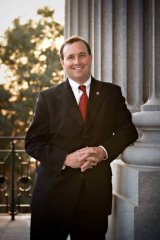
Breaking imported oil addiction must be top priority
By Rep. Jeff Duncan • November 24, 2008
Here in the Southeast, we recently saw severe gas shortages because of Hurricane Ike. All along the I-85 corridor, you couldn't find stations with gas, and when you did, you paid a steep premium for it. It was reminiscent of the 1970s oil crisis. The problem is despite the falling gas prices today, we are still going to be in a modern day oil crisis.
Advertisement
During this election, you undoubtedly saw the ads featuring Texas wildcat oilman Boone Pickens talking about our nation's addiction to foreign oil. He does a very good job in laying out the problem. And unlike most elected officials in Washington, he has a plan to solve the problem: Use America's abundance of wind and natural gas to break us of our addition to foreign oil.
Today we import some 70 percent of the oil we consume and we pay approximately $700 billion per year for it. As a country, we spend as much as the Wall Street bailout is projected to cost every year on imported oil. And forecasts show that we will continue to import more going forward unless we do something to change it.
In Washington, the solution of the day is "drill here, drill now." While that may make a good bumper sticker slogan, I think it's shortsighted and misses the mark. Drilling is good, but we need a lot more than that.
We need to take advantage of every resource we have here at home to provide energy. This does include more drilling, but also needs to include using clean coal, increased use of natural gas for transportation, looking at nuclear and investing in renewable resources.
The Pickens Plan uses power generated with wind to replace power generated from natural gas. The natural gas that wouldn't be needed for power generation could then be used to fuel large truck and fleet vehicles like city buses, municipal trash trucks and even some big city taxi fleets. This will cut down on the amount of oil consumed and lower the amount we spend on importing oil.
What I like most about the Pickens Plan is that instead of continuing to send $700 billion per year overseas for oil, we can start to invest some of the savings the United States. By investing in wind, natural gas, solar, cellulosic ethanol and a whole host of other renewable technologies here in the United States, we are investing in our economy, our jobs and our future.
Here in South Carolina, we could reap the benefits of those new technologies and new jobs.
That's one reason I have signed the Pickens Energy Independence Pledge and urge my fellow elected officials at all levels of government to do the same at www.pickensplan.com. As elected officials we have to show true leadership on this issue if we are going to break our addiction to imported oil.
Pickens has been asked several times why someone at his age -- he's 80 years old, by the way -- would be spending as much time and money as he is on this. His answer is simple. It's not for him, it's for our children and grandchildren. If we don't do something to tackle this problem now, their standard of living is at risk.
I have children of my own, and completely understand his answer.
Thursday, November 27, 2008
Op-Ed on Conservatism with Senator Kevin Bryant
Bryant/Duncan: Republicans must return to conservative roots
By KEVIN BRYANT and JEFF DUNCAN - Guest Columnists
Two years ago, following the first Republican bloodletting, our colleague Sen. Danny Verdin wrote that the election “turned not on the voters’ embrace of ideas offered by Democrats but the voters’ rejection of Republicans who abandoned them.” Today, following further losses in Congress and the loss of the White House, Sen. Verdin’s diagnosis stands out in bold. Republicans can blame no one but themselves for their exile.
Two years ago federal spending had increased 69 percent since 1994, and 49 percent since 2001 alone. It never stopped growing, and now the Heritage Foundation reports that it is 57 percent higher than 2001.
Republicans hoped two years ago that Randy Cunningham, Jack Abramoff and Mark Foley would be exceptions that prove the rule. However, corruption continues unabated. Alaska Republican Sen. Ted Stevens is a convicted felon, and of course there’s Idaho Republican Sen. Larry Craig.
The primary reason Republicans fell like a stone this year is that they have the sense of a box of rocks. A good friend of ours likes to say there’s no education in the second kick of the mule. The only hope therefore is that the second kick just received will rid of us of the folks who don’t seem to get the fact that the American public is tired of broken promises, hypocrisy and outright lies.
What the public does want is conservative leadership. Sen. Verdin pointed out two years ago that “The evidence clearly proves that conservative issues and candidates win.” Voters affirmed that fact again this year as they approved conservative measures and candidates from coast to coast.
Arizona approved a marriage amendment by 12 percentage points and increases in penalties on illegal hiring by 18 points. Arkansas passed a ban on adoptions by same-sex couples by 13 points. California voted for Obama by a 24 point margin, but it also preserved traditional marriage by 4 points. Florida went for Obama by 3 points and also preserved traditional marriage by 24.
San Francisco, the pit of despair for most conservatives, actually rejected the legalization of prostitution, a ban of Junior ROTC from high school campuses and the renaming of the sewer treatment plant for President Bush. Talk about hope for change.
Conservative candidates also won in Obama states. Obama carried Indiana, but so did the conservative governor, Mitch Daniels, by 18 points.
The 2008 election indicates that when voters in most places are given a chance to vote for conservatives or conservative positions, they do.
The majority of voters chose not, of course, to vote for John McCain. Sen. McCain would have earned more votes if he had presented more voters with a conservative choice.
We wish Sen. McCain had explained that the difference between a tax credit and “spreading the wealth” is that the former is when you keep your own money and the latter is when government takes your money and gives it to someone else.
We wish Senator McCain had not said that, “you don’t raise taxes in a bad economy” and instead said: “We have enough revenue in Washington. We don’t need to raise taxes at all.”
We really, really wish Sen. McCain had said in answer to Jim Lehrer’s question on whether he would support the bailout that not only would he not support it but also that he would lie down in the Senate floor before politicians stuck taxpayers with a $700 billion bill for a problem that politicians created in the first place. We really wish he had said that instead of, “oh of course I’ll vote for it.”
He did not, however, and therefore conservatives were left wondering whether Sen. McCain really believed in the same things they do. The majority of the Republican Party currently suffers from the same disease as Democrats before them and, for that matter, the same disease as Wall Street bankers. They simply believe that government is a good thing and more government must, by definition, be an even better thing.
Meanwhile, a recent survey indicates that while only 9 percent of voters believe that the Republican Party is too conservative, more than 60 percent believe it has either “lost its way” or become “incompetent.”
The voters get it. If Republicans ever want to regain the mandate of the voters, they need to take the hint: Do what you promise you’ll do, not what Democrats do.
Republicans do not need to search their souls. They need simply to revisit their principles. And this time, they need to stick to them.
Mr. Bryant represents Anderson County in the S.C. Senate. Mr. Duncan represents Laurens and Newberry counties in the S.C. House.


Monday, November 17, 2008
Wednesday, November 12, 2008
Real Economic Stimulus...Cheap Gas!
From UPI.com
Crude oil prices down as demand falters
Today's Price of Crude Oil
| 55.75 - (0.00% ) |
Quotes delayed at least 20 mins.
Crude oil prices fell $3.23 to $55.65 per barrel Wednesday on reports that China's imports had declined in October and U.S. gasoline consumption was behind last year's consumption level for the 29th consecutive week.
"With the global macro situation looking pretty lousy, we probably shouldn't be looking for a material rebound in oil prices until some time in 2009," Bart Melek, a global commodity strategist at BMO Capital Markets told The Wall Street Journal.
Heating oil prices also fell Wednesday, down 0.0991 cents to $1.825 per gallon. Reformulated blendstock gasoline fell 0.06 cents to $1.24 per gallon. Natural gas prices also fell, down 0.358 cents to $6.349 per million British thermal units.
At the pump, the average price for a gallon of regular unleaded gasoline was $2.202 Wednesday, down 0.018 cents from Tuesday's $2.22 a gallon, AAA said.
Monday, October 27, 2008
Obama on Firearms
This letter came to me from a friend in Illinois:
October 10, 2008
Fellow Sportsman,
Hello, my name is Rich Pearson and I have been active in the firearm rights movement for over 40 years. For the past 15 years, I have served in the Illinois state capitol as the chief lobbyist for the Illinois State Rifle Association.
I lobbied Barack Obama extensively while he was an Illinois State Senator. As a result of that experience, I know Obama’s attitudes toward guns and gun owners better than anyone. The truth be told, in all my years in the Capitol I have never met a legislator who harbors more contempt for the law-abiding firearm owner than Barack Obama.
Although Obama claims to be an advocate for the 2nd Amendment, his voting record in the Illinois Senate paints a very different picture. While a state senator, Obama voted for a bill that would ban nearly every hunting rifle, shotgun and target rifle owned by Illinois citizens. That same bill would authorize the state police to raid homes of gun owners and forcibly confiscate banned guns. Obama supported a bill that would shut down law-abiding firearm manufacturers including Springfield Armory, Armalite, Rock River Arms and Les Baer.
Obama also voted for a bill that would prohibit law-abiding citizens from purchasing more than one gun per month. Without a doubt, Barack Obama has proven himself to be an enemy of the law abiding firearm owner. At the same time, Obama has proven himself to be a friend to the hardened criminal. While a state senator, Obama voted 4 times against legislation that would allow a homeowner to use a firearm in defense of home and family.
Does Barack Obama still sound to you like a “friend” of the law-abiding gun owner?
And speaking of friends, you can always tell a person by the company they keep. Obama counts among his friends the Rev. Michael Pfleger - a renegade Chicago priest who has openly called for the murder of gun shop owners and pro-gun legislators. Then there is his buddy Richard Daley, the mayor of Chicago who has declared that if it were up to him, nobody would be allowed to own a gun. And let’s not forget Obama’s pal George Soros - the guy who has pumped millions of dollars into the UN’s international effort to disarm law-abiding citizens.
Obama has shown that he is more than willing to use other people’s money to fund his campaign to take your guns away from you. While a board member of the leftist Joyce Foundation, Barack Obama wrote checks for tens of millions of dollars to extremist gun control organizations such as the Illinois Council Against Handgun Violence and the Violence Policy Center.
Does Barack Obama still sound to you like a “friend” of the law-abiding gun owner?
By now, I’m sure that many of you have received mailings from an organization called “American Hunters and Shooters Association(AHSA)” talking about what a swell fellow Obama is and how he honors the 2nd Amendment and how you will never have to worry about Obama coming to take your guns. Let me make it perfectly clear - everything the AHSA says about Obama is pure hogwash. The AHSA is headed by a group of left-wing elitists who subscribe to the British view of hunting and shooting. That is, a state of affairs where hunting and shooting are reserved for the wealthy upper-crust who can afford guided hunts on exclusive private reserves. The AHSA is not your friend, never will be.
In closing, I’d like to remind you that I’m a guy who has actually gone nose to nose with Obama on gun rights issues. The Obama I know cannot even begin to identify with this nation’s outdoor traditions. The Obama I know sees you, the law abiding gun owner, as nothing but a low-class lummox who is easily swayed by the flash of a smile and a ration of rosy rhetoric. The Obama I know is a stony-faced liar who has honed his skill at getting what he wants - so long as people are willing to give it to him.
That’s the Barack Obama I know.
Sincerely,
(original signed)
Richard A. Pearson
Executive Director
Illinois State Rifle Association
Illinois State Rifle Association
420 E. Locust, P.O. Box 637, Chatsworth, IL 60921
Phone: (815) 635-3198 or (815) 635-3166 Fax: (815) 635-3723 Website: www.isra.org
Dedicated to education, safety training and support
of Illinois firearm owners
October 10, 2008
Fellow Sportsman,
Hello, my name is Rich Pearson and I have been active in the firearm rights movement for over 40 years. For the past 15 years, I have served in the Illinois state capitol as the chief lobbyist for the Illinois State Rifle Association.
I lobbied Barack Obama extensively while he was an Illinois State Senator. As a result of that experience, I know Obama’s attitudes toward guns and gun owners better than anyone. The truth be told, in all my years in the Capitol I have never met a legislator who harbors more contempt for the law-abiding firearm owner than Barack Obama.
Although Obama claims to be an advocate for the 2nd Amendment, his voting record in the Illinois Senate paints a very different picture. While a state senator, Obama voted for a bill that would ban nearly every hunting rifle, shotgun and target rifle owned by Illinois citizens. That same bill would authorize the state police to raid homes of gun owners and forcibly confiscate banned guns. Obama supported a bill that would shut down law-abiding firearm manufacturers including Springfield Armory, Armalite, Rock River Arms and Les Baer.
Obama also voted for a bill that would prohibit law-abiding citizens from purchasing more than one gun per month. Without a doubt, Barack Obama has proven himself to be an enemy of the law abiding firearm owner. At the same time, Obama has proven himself to be a friend to the hardened criminal. While a state senator, Obama voted 4 times against legislation that would allow a homeowner to use a firearm in defense of home and family.
Does Barack Obama still sound to you like a “friend” of the law-abiding gun owner?
And speaking of friends, you can always tell a person by the company they keep. Obama counts among his friends the Rev. Michael Pfleger - a renegade Chicago priest who has openly called for the murder of gun shop owners and pro-gun legislators. Then there is his buddy Richard Daley, the mayor of Chicago who has declared that if it were up to him, nobody would be allowed to own a gun. And let’s not forget Obama’s pal George Soros - the guy who has pumped millions of dollars into the UN’s international effort to disarm law-abiding citizens.
Obama has shown that he is more than willing to use other people’s money to fund his campaign to take your guns away from you. While a board member of the leftist Joyce Foundation, Barack Obama wrote checks for tens of millions of dollars to extremist gun control organizations such as the Illinois Council Against Handgun Violence and the Violence Policy Center.
Does Barack Obama still sound to you like a “friend” of the law-abiding gun owner?
By now, I’m sure that many of you have received mailings from an organization called “American Hunters and Shooters Association(AHSA)” talking about what a swell fellow Obama is and how he honors the 2nd Amendment and how you will never have to worry about Obama coming to take your guns. Let me make it perfectly clear - everything the AHSA says about Obama is pure hogwash. The AHSA is headed by a group of left-wing elitists who subscribe to the British view of hunting and shooting. That is, a state of affairs where hunting and shooting are reserved for the wealthy upper-crust who can afford guided hunts on exclusive private reserves. The AHSA is not your friend, never will be.
In closing, I’d like to remind you that I’m a guy who has actually gone nose to nose with Obama on gun rights issues. The Obama I know cannot even begin to identify with this nation’s outdoor traditions. The Obama I know sees you, the law abiding gun owner, as nothing but a low-class lummox who is easily swayed by the flash of a smile and a ration of rosy rhetoric. The Obama I know is a stony-faced liar who has honed his skill at getting what he wants - so long as people are willing to give it to him.
That’s the Barack Obama I know.
Sincerely,
(original signed)
Richard A. Pearson
Executive Director
Illinois State Rifle Association
Illinois State Rifle Association
420 E. Locust, P.O. Box 637, Chatsworth, IL 60921
Phone: (815) 635-3198 or (815) 635-3166 Fax: (815) 635-3723 Website: www.isra.org
Dedicated to education, safety training and support
of Illinois firearm owners
Saturday, October 25, 2008
Agriculture is BIG in South Carolina!
Study: Agribusiness is a $34 billion economic engine in state
Agriculture, forestry eclipse manufacturing and toursim as S.C.'s cash cow
Agribusiness is South Carolina's No. 1 industry, ahead of manufacturing and tourism. Anderson County farmer Brian Clinkscales' Triple C Farms in Starr raises swine and cattle.
A study conducted by the South Carolina Agribusiness Council and the South Carolina Forestry Association shows agriculture and forestry have eclipsed manufacturing and tourism as the state’s largest economic segment.
Harry Miley of Miley Gallo and Associates, a Greenville-based economic consulting firm, estimated that South Carolina’s agribusiness, which includes all aspects of farming and forestry, annually contributes $33.9 billion to the South Carolina economy and employs an estimated 200,000 residents.
“The bottom line is that South Carolina’s oldest industry has entered the 21st century with great promise in the emerging economy,” Miley said in a statement.
And, while technology and manufacturing remain at the forefront of many state and county economic initiatives, the role of agribusiness and the need to encourage local agricultural production and consumer awareness should not be underestimated, he said.
“South Carolina’s agribusiness is so much larger than most people realize,” said Evin Evans, co-owner of Split Creek Dairy Farm in Anderson. “Producing, packaging and transporting food is an enormous industry and contributes a great deal to the state economy in terms of tax revenue and job creation.”
Evans said that “agribusiness, which is everything from growing food to raising cattle to insuring farm equipment or selling supplies, is the jewel in South Carolina’s own backyard.”
Edgar Woods of the Palmetto Agribusiness Council echoed Evans’ sentiment.
“The industry that provides consumers with food is one of the dominant economic forces in our state and the challenge remains for our leaders to continue encouraging the development of new technologies and methods in support of that industry,” Woods said.
Besides the economic impact, another less obvious benefit is derived from the consumption of locally grown food — economic independence and security.
“Just like foreign oil, we can ill afford to become dependent on foreign food,” Evans said. “It is harder to inspect products for contamination when they are grown in foreign soil. It also costs a great deal more in terms of logistics, and the only ones who gain are the multinational food distribution companies.”
Jim Smith, founding director of South Carolina’s Upstate School of Sustainable Agriculture, said consumers are becoming increasingly aware of the origins of their food, from where it is grown to how it is fertilized and stored.
“The demand from restaurant owners and consumers for locally grown, organic food is outstripping supply,” Smith said.
He cited a variety of factors are contributing to the increased demand, including a desire many consumers have to buy local, organic produce rather than what is shipped in from outside sources.
Forestry officials said emerging technologies for alternative fuels will help the agribusiness sector grow even faster.
“This is just the beginning compared to what we are likely to see in the coming decades,” said Bob Scott, president of the S.C. Forestry Association, in a statement. “Whether its carbon credits or biofuels, South Carolina will be on the cutting edge.”
State Rep. Jeff Duncan, a member of the House Agriculture Committee, called on members of the state legislature to look closely at the results of the Miley study.
“Agriculture should not be seen as what our state used to be,” Duncan said in a statement. “It’s the backbone of our economy.
“As elected officials, we have a responsibility to do all we can to support growth in the agribusiness sector,” he said. “Our future depends on it.”
To learn more about “agribusiness” in South Carolina, go to www.carolinafarmsteward.org.
Monday, October 20, 2008
Justice Clarence Thomas is Right on the Money
From the Wall Street Journal - Monday, October 20, 2008
How to Read the Constitution
The following is an excerpt from Supreme Court Justice Clarence Thomas's Wriston Lecture to the Manhattan Institute last Thursday:
When John F. Kennedy said in his inaugural address, "Ask not what your country can do for you -- ask what you can do for your country," we heard his words with ears that had been conditioned to receive this message and hearts that did not resist it. We heard it surrounded by fellow citizens who had known lives of sacrifice and hardships from war, the Great Depression and segregation. All around us seemed to ingest and echo his sentiment and his words. Our country and our principles were more important than our individual wants, and by discharging our responsibilities as citizens, neighbors, and students we would make our country better. It all made sense.
Today, we live in a far different environment. My generation, the self-indulgent "me" generation, has had a profound effect on much around us. Rarely do we hear a message of sacrifice -- unless it is a justification for more taxation and transfers of wealth to others. Nor do we hear from leaders or politicians the message that there is something larger and more important than the government providing for all of our needs and wants -- large and small. The message today seems more like: Ask not what you can do for yourselves or your country, but what your country must do for you.
This brings to mind the question that seems more explicit in informed discussions about political theory and implicit in shallow political speeches. What is the role of government? Or more to the point, what is the role of our government? Interestingly, this is the question that our framers answered more than 200 years ago when they declared our independence and adopted our written Constitution. They established the form of government that they trusted would be best to preserve liberty and allow a free people to prosper. And that it has done for over two centuries. Of course, there were major flaws such as the issue of slavery, which would eventually lead to a civil war and casualties of fellow citizens that dwarf those of any of the wars that our country has since been involved in.
Though we have amended the Constitution, we have not changed its structure or the core of the document itself. So what has changed? That is the question that I have asked myself and my law clerks countless times during my 17 years on the court.
As I have traveled across the country, I have been astounded just how many of our fellow citizens feel strongly about their constitutional rights but have no idea what they are, or for that matter, what the Constitution says. I am not suggesting that they become Constitutional scholars -- whatever that means. I am suggesting, however, that if one feels strongly about his or her rights, it does make sense to know generally what the Constitution says about them. It is at least as easy to understand as a cell phone contract -- and vastly more important.
The Declaration of Independence sets out the basic underlying principle of our Constitution. "We hold these truths to be self-evident, that all men are created equal, that they are endowed by their Creator with certain unalienable Rights, that among these are Life, Liberty, and the pursuit of Happiness. -- That to secure these rights, Governments are instituted among Men, deriving their just powers from the consent of the governed . . . ."
The framers structured the Constitution to assure that our national government be by the consent of the people. To do this, they limited its powers. The national government was to be strong enough to protect us from each other and from foreign enemies, but not so strong as to tyrannize us. So, the framers structured the Constitution to limit the powers of the national government. Its powers were specifically enumerated; it was divided into three co-equal branches; and the powers not given to the national government remained with the states and the people. The relationship between the two political branches (the executive and the legislative) was to be somewhat contentious providing checks and balances, while frequent elections would assure some measure of accountability. And, the often divergent interests of the states and the national government provided further protection of liberty behind the shield of federalism. The third branch, and least dangerous branch, was not similarly constrained or hobbled.
Since Marbury v. Madison the federal judiciary has assumed the role of the interpreter and, now, final arbiter of our Constitution. But, what rules must judges follow in doing so? What informs, guides and limits our interpretation of the admittedly broad provisions of the Constitution? And, more directly, what restrains us from imposing our personal views and policy preferences on our fellow citizens under the guise of Constitutional interpretation?
To assure the independence of federal judges, the framers provided us with life tenure and an irreducible salary -- though inflation has found a way around the latter. This independence, in turn, was to assure our neutrality and impartiality, which are at the very core of judging -- and being a judge. Yet, this independence can also insulate a judge from accountability for venturing beyond the proper role of a judge. But, what exactly is the proper role of a judge? We must understand that before we can praise or criticize a judge. In every endeavor from economics to games there is some way to measure performance.
As important as our Constitution is, there is no one accepted way of interpreting it. Indeed, for some commentators, it seems that if they like or prefer a particular policy or conduct, then it must be constitutional; while the policies that they do not prefer or like are unconstitutional. Obviously, this approach cannot be right. But, it certainly is at the center of the process of selecting judges. It goes something like this. If a judge does not think that abortion is best as a matter of policy or personal opinion, then the thought is that he or she will find it unconstitutional; while the judge who thinks it is good policy will find it constitutional. Those who think this way often seem to believe that since this is the way they themselves think, everyone must be doing the same thing. In this sense, legal realism morphs into legal cynicism. Certainly this is no way to run a railroad, not to mention interpret the Constitution. . . .
Let me put it this way; there are really only two ways to interpret the Constitution -- try to discern as best we can what the framers intended or make it up. No matter how ingenious, imaginative or artfully put, unless interpretive methodologies are tied to the original intent of the framers, they have no more basis in the Constitution than the latest football scores. To be sure, even the most conscientious effort to adhere to the original intent of the framers of our Constitution is flawed, as all methodologies and human institutions are; but at least originalism has the advantage of being legitimate and, I might add, impartial.
Right-on, Justice Thomas, Right-on!!!
Subscribe to:
Posts (Atom)